Does Your Self-Hosted Application Need Persistent Connections? A WebSockets, SSE and Long-Polling Checklist
A practical, protocol-neutral guide to deciding whether a self-hosted application needs WebSockets, Server-Sent Events or long polling—and what that choice means for routing, authentication, scaling, monitoring and failure planning.
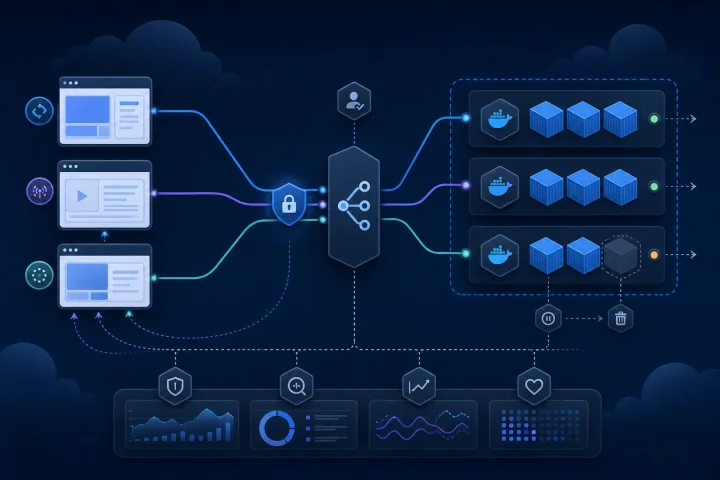
Why persistent connections are an application-selection question, not just a proxy setting
A persistent connection requirement changes more than a reverse-proxy configuration. It affects the network path between a user and the application, how deployments are drained, what happens after authentication changes, how multiple application instances coordinate, and which signals operators need during an incident.
Start with the user experience rather than a protocol preference. An application may work perfectly well with ordinary request-response HTTP for administrative work, periodic reporting and non-urgent updates. Other experiences can feel incomplete when updates are delayed or when an interactive session repeatedly reconnects. The right question is not “Can the proxy support WebSockets?” but “What user workflow depends on an open or repeatedly held connection, and what is the acceptable behaviour when it is unavailable?”
For a managed deployment, confirm the requirements in the application vendor’s current documentation and test the actual workflow after deployment. Airbip runs application instances as Docker workloads on cloud servers and automates routing and TLS certificates through Traefik and Let’s Encrypt. That can simplify the infrastructure around a supported application, but it does not replace the need to validate application-specific real-time behaviour, identity design, data handling and operational ownership.
- Identify the exact screen, workflow or integration that needs timely delivery.
- Define whether the application needs server-to-browser updates only, or two-way interactive messaging.
- Record the expected fallback: refresh, periodic polling, delayed notification, retry queue or a clear offline state.
- Treat real-time transport requirements as an acceptance criterion before migration, not as a post-launch tuning task.

WebSockets, Server-Sent Events and long polling: what differs operationally
WebSockets begin with an HTTP opening handshake and then exchange framed messages over the established connection. They are suitable when an application needs a continuing, bidirectional channel. RFC 6455 also defines Ping and Pong control frames, which endpoints can use for liveness or responsiveness checks.
Server-Sent Events, commonly called SSE, use the browser EventSource interface and the text/event-stream media type. SSE is designed for server-to-page event delivery. It is often a good fit when the browser primarily receives updates and sends any commands through ordinary HTTP requests. EventSource reconnects after a connection closes unless the server sends HTTP 204 No Content; it can also provide a Last-Event-ID header when reconnecting, allowing the server to determine the last event identifier received.
Long polling holds an HTTP request until an update, status change or timeout, after which the client usually opens another request. It can work through familiar HTTP infrastructure, but each delivery remains a full HTTP request-response exchange. Outstanding requests consume resources in clients, servers, gateways and proxies, so its operating characteristics deserve deliberate testing at expected concurrency.
- Choose WebSockets when the product requires a continuing two-way channel and the vendor documents that transport.
- Consider SSE for one-way server-to-browser streams with HTTP requests used for client actions.
- Consider long polling where the application supports it and near-real-time updates are useful but a continuously upgraded connection is unnecessary.
- Do not assume one pattern is inherently simpler: operational complexity depends on the application, client behaviour and every intermediary in the route.

Which user experiences may depend on persistent connections
Persistent connections are usually justified by interaction patterns, not by a category label such as CRM, analytics or collaboration. A live presence indicator, a shared editing surface, a continuously updating operational console, a streamed AI response or an in-product notification feed may depend on timely server delivery. Yet the same application can often contain many pages that do not need it.
Classify each workflow by consequence. A delayed dashboard refresh may be tolerable. A control interface that leaves an operator uncertain whether an action was received may not be. Likewise, a collaboration feature may need to show that its live channel is reconnecting rather than silently displaying stale state.
Ask the vendor whether the behaviour is required for correctness, preferred for responsiveness, or merely an optional enhancement. Also ask whether the application has a supported degraded mode. Do not infer transport requirements from product marketing or from the presence of a browser interface.
- Collaboration: shared state, presence, comments or alerts may need fast propagation.
- Operational interfaces: status changes, job progress and alerts may need an explicit freshness indicator.
- Notifications: determine whether delayed email or in-app retrieval is an acceptable fallback.
- AI interfaces: distinguish a streamed response from a request that can simply complete before displaying its result.
- Integrations: establish whether incoming events, outgoing delivery confirmations or both rely on a long-lived channel.
A pre-adoption checklist: vendor documentation, network path, authentication, scaling and failure behaviour
Before adopting or migrating an application, build a short evidence-backed connection profile. The application vendor’s documentation should be the primary source for supported transports, endpoint paths, required headers, authentication behaviour, proxy guidance, multi-instance design and expected fallback behaviour. If documentation is unclear, test the specific workflow in a representative environment rather than making assumptions.
Map the full route: browser or client, DNS, TLS termination, content delivery or security layer if present, reverse proxy, load balancer, application workload and any message-sharing component the application requires. A setting that appears correct at the application edge may be defeated by an earlier intermediary with a shorter idle timeout or a connection policy that does not permit the intended traffic.
Authentication needs special attention because a connection may outlive a page request. Establish how the application authenticates the initial connection, how it handles expired credentials, and what happens when access is revoked while a channel is open. Treat those as application-specific design questions to verify, not universal transport properties.
- Obtain the vendor’s proxy and scaling documentation for the intended deployment mode.
- List every network intermediary and its connection, header and timeout policies.
- Verify TLS and custom-domain requirements; Airbip supports an Airbip subdomain or a compatible custom domain.
- Document authentication at connection establishment, token or session expiry, logout and access revocation.
- Test expected reconnects, browser refreshes, application restarts and temporary proxy unavailability.
- Confirm the application’s supported model for multiple instances before designing for horizontal scale.
Questions to ask a managed host or internal platform team
The useful questions are concrete and tied to the application’s documented behaviour. A platform team can explain the routing layer, domain and certificate process, lifecycle controls, backup approach and the boundaries of its service. It cannot responsibly promise that an undocumented application transport, client library or third-party integration will behave correctly without validation.
For Airbip deployments, relevant starting points include the application’s Docker workload model, routing and TLS automation through Traefik and Let’s Encrypt, DNS checks, service lifecycle management, and configurable daily, weekly and monthly backups. Backups are important for recoverability, but they are not a substitute for connection draining, client retry logic or a tested real-time failure mode.
- Does the planned application version document WebSocket, SSE or long-poll endpoints and proxy requirements?
- Where does TLS terminate, and are secure WebSocket connections supported across the intended route?
- Which timeout settings apply at the routing layer, and which upstream layers impose their own limits?
- Can the application be restarted or updated with a defined user-facing reconnection experience?
- If more than one application instance is used, what component shares events, presence or connection-related state?
- What logs and metrics are available during a connection incident?
- Which responsibilities remain with the customer for user access, application configuration, data retention and governance?
Reverse proxies and load balancers: upgrades, timeouts, forwarded headers and connection limits
For WebSockets, validate the HTTP opening handshake through the entire route. Traefik documents support for WS and WSS without a separate WebSocket middleware and states that it preserves relevant handshake headers such as Origin and Sec-WebSocket-Key. This is useful infrastructure behaviour, but the deployed application must still accept the public origin, construct correct external URLs and enforce its own security rules.
Forwarded headers matter when an application needs to know the original host, scheme or client address. Traefik automatically adds X-Forwarded-For, X-Real-Ip, X-Forwarded-Host, X-Forwarded-Port, X-Forwarded-Proto and X-Forwarded-Server while proxying. Verify how the application trusts and interprets forwarded headers, especially where another proxy exists in front of the routing layer.
Timeouts should be assessed as a chain. Traefik entry points expose read, write and idle timeout settings. For long polling, RFC 6202 notes that a server or intermediary can end a pending request with HTTP 408 or HTTP 504, and the limiting timeout may be in infrastructure rather than in the browser. SSE may need periodic keepalive output because some legacy proxies can close an otherwise idle HTTP connection. Connection limits, file-descriptor capacity and upstream resource use also need review at the expected number of simultaneous clients.
- Confirm WebSocket handshake and upgrade behaviour end to end, not only at the final proxy.
- Align application heartbeats or keepalives with the shortest relevant idle policy, where the application supports them.
- Set and test long-poll request durations against server and intermediary timeouts.
- Suppress inappropriate caching for long-poll routes using standard HTTP cache controls.
- Verify origin handling and the application’s proxy-trust configuration.
- Capacity-test concurrent open connections and observe proxy, host and application resource pressure.
How persistent connections affect multi-instance deployments and session design
A single application instance may avoid many distributed-systems questions, but it does not remove the need for reconnect and restart handling. Once traffic is served by multiple instances, a connected client may be attached to one instance while an event is created on another. If the application requires broadcasts, shared presence or delivery to users connected elsewhere, it needs its documented mechanism to share messages or connection-related events across instances.
HAProxy’s WebSocket guidance illustrates the underlying issue: each WebSocket server has its own connected-client list, so cross-server delivery or broadcasting requires messages to be shared among servers. Load-balancer affinity may be relevant for some application session models, but it is not a general replacement for shared state. It cannot make an event known to an instance that has not received it.
Review state separately: user sessions, authorization state, connection ownership, subscription state, event history and background jobs may each have different storage or coordination requirements. Scale only with an architecture the vendor supports, and test a client reconnecting to a different instance.
- Determine whether the application officially supports more than one active instance.
- Identify where sessions, subscriptions and event history are stored.
- Confirm how cross-instance broadcasts and targeted delivery are propagated.
- Test loss of one instance while clients remain connected to others.
- Do not rely on load-balancer affinity as the sole design for shared events or durable state.
- Ensure reconnecting clients can restore state or safely request a current view.
Monitoring signals: connected clients, disconnects, reconnect rates, error patterns and resource pressure
Persistent channels need observability that distinguishes a healthy quiet connection from a broken one. Collect connection counts where the proxy or application exposes them, but interpret them alongside connection age, disconnect reasons, reconnect attempts, handshake failures, response errors and user-visible freshness. There is no universal healthy threshold: normal levels depend on the application’s client population, expected session duration, release activity and traffic shape.
Track both service and client behaviour. A rising disconnect rate can indicate a timeout mismatch, network interruption, deployment event or application issue. A reconnect surge after a service recovery can create its own load spike. RFC 6455 recommends delayed reconnects with increasingly longer delays after abnormal closure, helping clients avoid overwhelming a recovering service.
Resource monitoring remains essential. Long polling can accumulate outstanding HTTP requests. Long-lived connections can hold sockets and consume proxy, operating-system and application resources. Monitor relevant connection capacity, CPU, memory, network activity and error logs across the full path, then investigate changes against a baseline rather than relying on borrowed numeric targets.
- Current and peak connected clients, segmented by endpoint where available.
- Handshake failures, authorization failures and unexpected response codes.
- Disconnect reasons and connection-duration distribution.
- Reconnect rate, retry delay behaviour and correlated deployment or network events.
- Long-poll outstanding requests and timeout responses such as 408 or 504.
- Proxy, host and application CPU, memory, socket and network-resource pressure.
- A user-facing freshness or disconnected indicator where the application provides one.
Frequently asked questions
Do all self-hosted applications need WebSockets?
No. Many applications work well with ordinary HTTP. WebSockets are appropriate only when the application’s documented workflow needs a continuing bidirectional channel. SSE, long polling or periodic refresh may be more appropriate in other cases.
Is SSE a replacement for WebSockets?
Not generally. SSE is designed for server-to-page event delivery using EventSource and text/event-stream. WebSockets support framed messages in both directions after the opening handshake. The right choice depends on the application’s documented transport and interaction model.
Why does long polling need timeout testing?
A long-poll request can be ended by the application server or an intermediary. RFC 6202 notes that infrastructure timeouts can be shorter than browser timeouts and may result in HTTP 408 or 504 responses. Test the whole network path.
Do load-balanced WebSocket applications need shared state?
When clients connected to different instances must receive the same broadcasts or cross-instance messages, the application needs a documented way to share those messages or connection-related events. Session affinity alone does not solve cross-instance delivery.
What should users see if a real-time channel fails?
Prefer an explicit, understandable state: reconnecting, temporarily disconnected or data may be delayed. Where supported, offer a safe fallback such as refresh, retry or delayed retrieval. Avoid silently presenting stale data as live.
Can Airbip host applications that use persistent connections?
Airbip deploys catalog applications as Docker workloads on cloud servers and automates routing and TLS through Traefik and Let’s Encrypt. Traefik supports WS and WSS. Confirm the specific application’s documented transport, proxy, scaling and failure requirements before deployment, particularly for multi-instance or high-concurrency designs.
Sources and further reading
- RFC 6455: The WebSocket Protocol — IETF / RFC Editor
- Server-sent events — WHATWG HTML Standard
- RFC 6202: Known Issues and Best Practices for the Use of Long Polling and Streaming in Bidirectional HTTP — IETF / RFC Editor
- WebSocket configuration tutorial — HAProxy Technologies
- WebSocket support — Traefik Labs
- Traefik Headers middleware reference — Traefik Labs
- Traefik EntryPoints reference — Traefik Labs
- Docker Compose services reference — Docker
- Explore Termination Behavior for Pods and Their Endpoints — Kubernetes